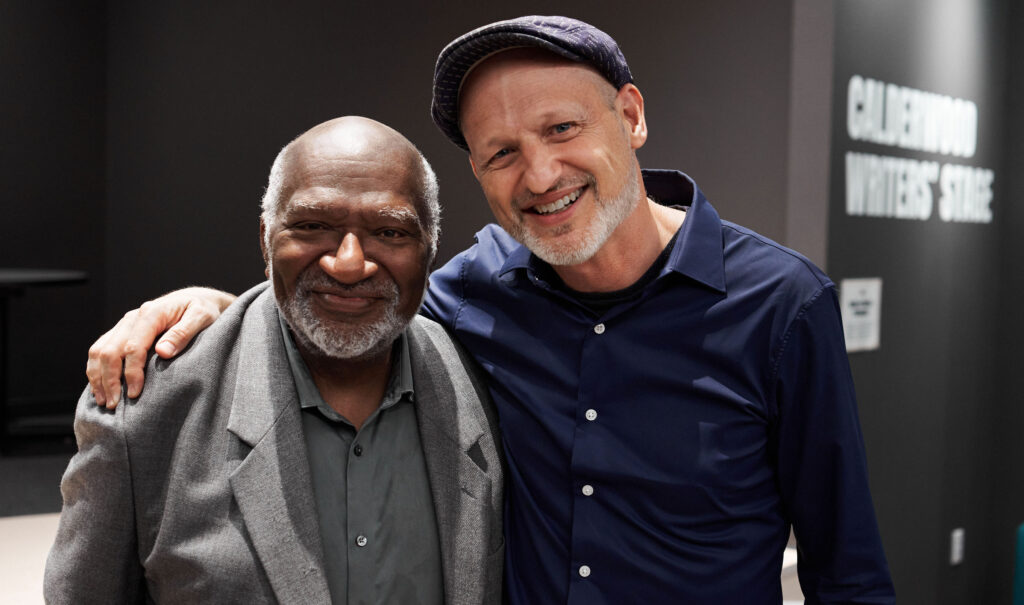
“Well, what attracted me to the city was the music scene. There was just a tremendous amount of music going on, rock and roll, jazz,” Charles mused about arriving in Boston in 1974. In our oral history interview in 2018, Charles, aged 68, spoke movingly about his family, writing, loss, racial strife, how to play the digeridoo, dropping out of college to join a rock band, and his deep love of Boston and its people. On the spot, Charles even sang, acapella, a “St. James Infirmary”-style blues of his own titled, “Black and Gold.” “O’ Lord, forgive me for my sins,” Charles began. “The lights in here are getting dim. I wish they’d turn them up, again.” As he closed his eyes and sang into the microphone, I recall feeling that Charles’ deep baritone voice rose up from the earth below my feet.
“In Boston, people can be crusty, but the friendships are real. There are people you can call at 3 in the morning, and say, ‘I need to go the emergency ward,’ and they’ll be there in 15 minutes,” shared Charles for my oral history project titled, “We Are Boston: Stories of Hope, Struggle, and Resilience.” Though I hadn’t seen Charles in several months prior to his November 21st death from prostate cancer, I’d like to think that he would have called, if he felt the need. We mostly spoke by phone, and I often called him out-of-the-blue, to set up a dumpling lunch in Boston’s Chinatown.
Ever the pun-maker, Charles jokingly referred to these noon-time junkets as “fat-finding missions.” During these languorous, laugh-filled lunches at Dumpling Café, Charles would order for both of us. Together, often in winter, we would eat soup dumplings, pork gyoza, ginger-garlic fish, steamed bok choy, jasmine rice, and drink hot tea. As the windows steamed over, we shared food. We shared poems. We told stories. Both of us knowing, at some point, we needed to settle our tab, walk back into the stinging cold, and return to our arts administration posts, mine at 826 Boston and Charles’ at the Massachusetts Cultural Council (MCC), yet neither of us moved. We lingered, a bit longer, over hot cups of gunpowder tea, as fast friends do.
At one of these countless meet ups in Chinatown, I shared a draft poem I had written for my friend James Foley, a conflict reporter, who had gone missing in Syria. When I looked up, tears welled in Charles’ umber eyes. He set down his teacup, put his big, warm hand on mine, and said, “I’m sorry about your friend Jim.” As someone who prized deep friendships, Charles spurred me on to keep writing poems about James Foley. In 2023, Charles shared the stage with me and my wife Ebele at GrubStreet’s Center for Creative Writing. Charles read poems from Purgatory Road. Ebele and I performed poems from Shadow Act: An Elegy for Journalist James Foley. In a gray blazer and gray shirt, Charles cast a spell that night from the Calderwood Stage as only a great jazz and blues man could do.
“Well, I don’t think you ever recover from loss in a certain way. It’s just like after an earthquake, the ground shifts and then settles, but it’s settled in a new pattern. And so, you learn to live with that new pattern.”
-Charles Coe in our 2018 oral history interview
Over the years, while serving as Mass Poetry’s executive director, I had the good fortune to collaborate and talk with Charles dozens of times. It seems impossible I won’t see him, again, say, at the Grolier Poetry Book Shop or, once more, gracing the stage at the Massachusetts Poetry Festival. In writing and life, we cheered each other on, kept close tabs. After Charles received a Boston Artist-in-Residence (A.I.R.) fellowship, he encouraged me to apply for the same. A decade earlier, shortly after I met Charles, he emceed an open house at 826 Boston to help raise awareness of the fledgling youth writing center in Roxbury’s Egleston Square. True to form, Charles read some new work, cracked jokes, sang a song or two, and graciously shared the stage with dancers, poets, and politicians. In the wake of Charles’ blessing, 826 Boston has since spawned thousands of poems and stories by youth writers.
Time to time, I would call Charles at the MCC to talk about funding opportunities, and he would greet me, “Dan the Man,” or “Well, if it isn’t the major domo.” Inevitably, the talk would turn to poetry, books, our creative projects, and soon our need to meet up, again, in Chinatown, post haste. After Charles retired from the MCC, he launched a heady, restless blaze of creative projects including a family memoir, novella, screenplay, short film, a third collection of poetry, and countless musical projects.
Surely, in his retirement, at quiet moments in his West Cambridge home, Charles must have heard the ticking down of his kitchen clock. In the last year, Charles wrote openly about his battle with cancer on Facebook in what he dubbed, “The Prostate Cancer Chronicles.” Of his battle, Charles wrote, “My recent surgery, this little brush with mortality, has me thinking back on all the people in my life I’ve lost along the way.” Following his diagnosis, with characteristic verve, Charles continued writing, gigging, teaching, and exploring new creative passions. Late in life, for example, he threw himself into learning to play the digeridoo, an aboriginal reed instrument up to 10-feet-long, that requires circular breathing of its player. “It’s basically a eucalyptus branch with the pulp hollowed out. It’s the world’s oldest instrument,” Charles explained with a giddy grin.
During our interview, I asked Charles about how loss informs his writing and art, knowing that grief had rocked his own life. Over time, Charles lost both of his parents, his mother Edith and father Connie, and his sister Carol. “Well, I don’t think you ever recover from loss in a certain way. It’s just like after an earthquake, the ground shifts and then settles, but it’s settled in a new pattern. And so, you learn to live with that new pattern.” Charles is right—and, yet I find myself stunned, unsure, after this sudden, seismic loss.
I’m heartened to know, however, that the City of Boston Archives has preserved our interview for posterity, and that future generations will get the chance to hear Charles speaking to them, out-of-time. And, if they stumble across it, Bostonians might even get to step into my 1930’s-era phonebooth retrofitted as a “traveling oral history booth” and hear Charles’ voice themselves. “I got to Boston a few months before Ted Landsmark was attacked with a flag on City Hall Plaza. And that photo was on the front page of just about every newspaper in the country. My mother saw it and called me, hysterical,” Charles recalls. Most recently on display at the Mattapan Branch Library, the walnut phone booth houses a rotary phone with which visitors can dial up snippets of interviews shared by 13 Bostonians, ages 58 to 85, hailing from Dorchester, East Boston, Roxbury, Charlestown, Mattapan, and more.
When I walk into Friends Meeting House for a memorial event on January 24th, I know that I’ll be looking for Charles—the ursine man himself, a boyish glimmer in his eye—for him to single me out with a quirky moniker, a bear hug, a one-liner to get me laughing, his paw on my shoulder, his deep, whiskey voice in my ear. In my copy of Purgatory Road, Charles penned this dedication, “To Daniel—My poetic partner in crime—Charles.” It’s an apt inscription, since poetry brought us together, again and again. This brief, lower-cased, Clifton-esque lyric closes Purgatory Road. Sadly, it serves as a fitting sign off from one of my favorite poets, polymaths, pun-makers, and lunch companions, gone-too-soon:
in the days to come
in the days to come
when i have gone
to where i am going
sometimes when you
walk along the shore
stop for a moment
bare toes in warm sand
gaze at the rainbow sky
and i’ll be there
the salt spray
kissing your cheek